Security engineer · Singapore · GCIH
Somewhere in the logs is one line that explains it. I find that line.
- 15:51:55causesystemd[1]: Reloading finished in 623 ms.
- 15:54:31symptomjellyfin: FFmpeg exited with code 187
- 15:54:31symptomffmpeg: cuInit(0) failed -> CUDA_ERROR_NO_DEVICE
- 15:56:01symptomimmich_ml: Failed to initialize NVML: Unknown Error
- 15:57:00symptomllm: Failed to initialize NVML: Unknown Error
- 15:57:02host: nvidia-smi reports both GPUs healthy
Everyone reads the red lines. The answer was the routine one above them. Read the case
- Role
- Security engineer, blue team background
- Focus
- Detection, security engineering and the infrastructure underneath
- Based in
- Singapore
- Credentials
- GCIH · BSc Computer Science, first class · TISC CTF Level 5
- Evidence
- 4 case studies, 7 root-cause write-ups, 4 tested detections
What they said. What it was.
Seven problems from systems I run, each traced to one named cause and written up so the next person searching the error finds the fix.
the symptom, as reportedthe root cause
- 10 Sept 2026 A per-minute request cap let through several times the cap. KV reads are cached for a minute. A stale counter cannot enforce a window.
- 9 Sept 2026 Ad blocking stopped on one phone. The filter logged nothing. iCloud Private Relay resolves names through Apple, so the filter was never asked.
- 8 Sept 2026 One TV channel played everywhere except my media server. ffmpeg 7.1 refuses video segments whose URL has no file extension.
- 7 Sept 2026 Three GPU services died at the same minute and nothing logged an error. A systemd reload wiped device rules Docker never knew about.
- 6 Sept 2026 The emulator rejected every disc image I dumped. Full dumps put the game partition at 0x18310000. The emulator reads 0x10000.
- 5 Sept 2026 Game streams worked but looked soft and lagged. The encoder was built without this GPU's kernels and silently fell back to the CPU.
- 30 Aug 2026 A 35B model ran at 46 tokens a second. Was that the hardware? No. Runtime and four defaults. 71 tokens a second on the same cards.
Work
Things I designed, built and keep running. Each has a case study with the decisions and the mistakes.
-
Product suite, solo
Versed
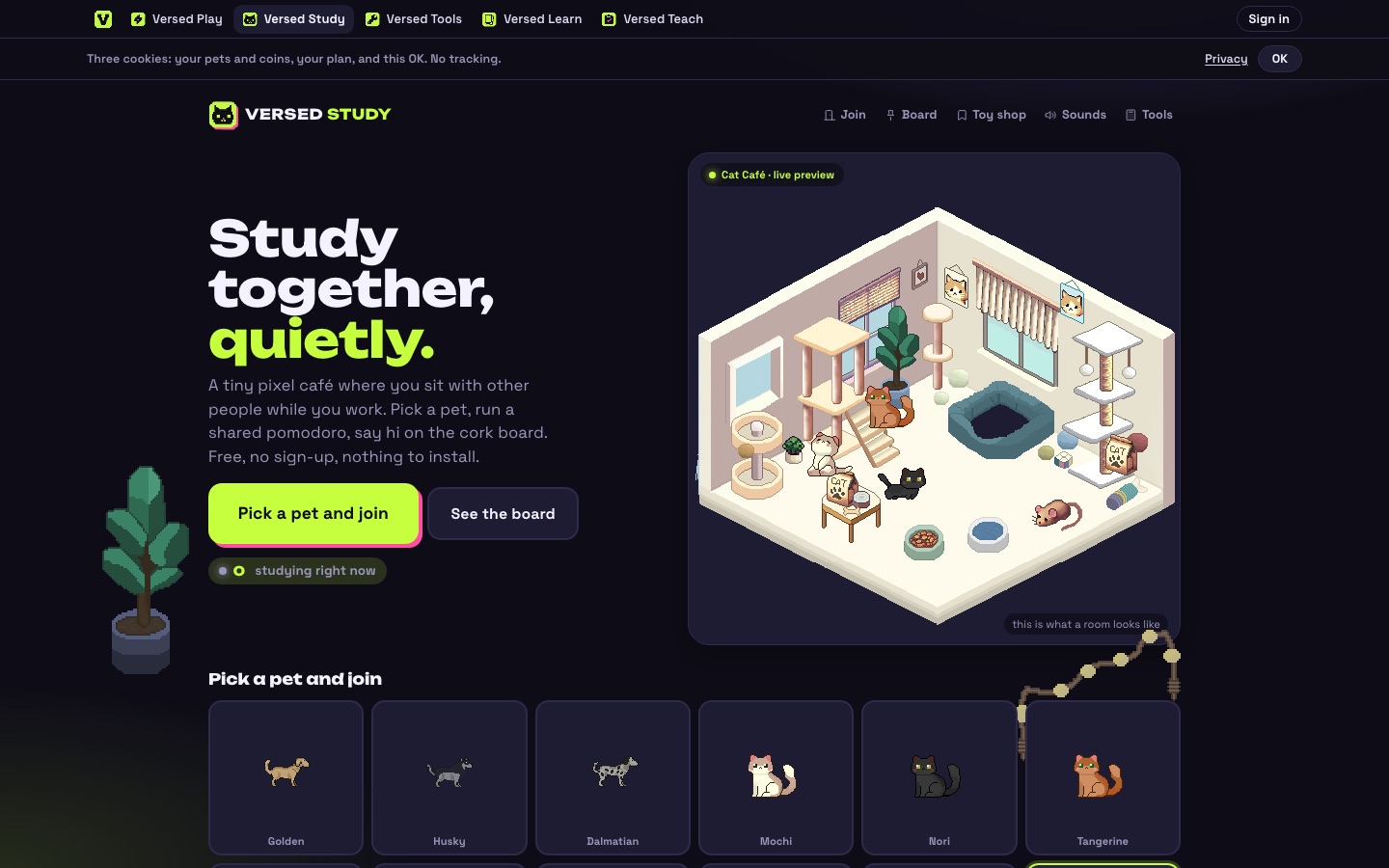
Four free learning tools for students, tutors and teachers, designed, built and run by one person on Cloudflare's edge. No sign-up to play, no tracking, no budget.
- 4 products live
- 0 accounts needed to play
- 1 person: design, code, ops
-
Infrastructure, self-hosted
One box, forty services
A recycled gaming PC running forty-odd containers for my family: photos, passwords, media, DNS filtering, game streaming and local AI. Reachable from anywhere, with no port open to the internet.
- 40+ services
- 0 ports open to the internet
- 14 days of restorable backups
-
Performance engineering
Local AI on 2017 hardware
Getting a 35-billion-parameter model to 66 tokens a second on two GTX 1080 Tis by measuring every assumption, including the ones in the documentation.
- 46 to 71 tokens a second
- +44% on the same hardware
- 1 crash found before it shipped
-
Blue team, Python
Detection tooling
Small, tested tools from my defensive security practice: a log triage pipeline that pairs rule-based detection with an LLM classifier, a phishing link analyser, and hand-written Snort and iptables rules.
- 4 Sigma rules, ATT&CK mapped, green in CI
- 36 offline tests on the triage tool
- 3 public repositories with passing builds
Smaller builds
- Exam-practice tutoring appStudent and teacher web app for primary school English, built with a partner who owns the backend. Hint ladders that fade as mastery grows, and a teacher view of every attempt. In development.
- Futures trading botOpening-range-breakout strategy with an LLM as the final filter, broker execution, and guard rails that enforce drawdown and position limits. Paper traded.
- Game library intakeIdentifies disc images by their magic bytes, converts the formats emulators refuse, and files everything where the front ends expect it.
Detections
Sigma rules written from things I have investigated. Every rule has events it must match and events it must not, and converts to Splunk and Elastic queries.
| Rule | ATT&CK | Log source | Tests |
|---|---|---|---|
| System DLL loaded from a user-writable pathDLL search-order hijacking. Written from a Sysmon lab where a copied calc.exe loaded a planted WININET.dll. | T1574.001 | Sysmon event 7 | 4 passing |
| .NET runtime loaded by a process that is not a .NET hostUnmanaged PowerShell: the CLR injected into a native process so PowerShell runs with no powershell.exe in the process log. | T1059.001T1055 | Sysmon event 7 | 3 passing |
| SSH password brute force from one sourceTen failed passwords from one address in five minutes, as a Sigma correlation rule. Ported from my log triage tool. | T1110.001 | sshd auth log | 2 passing |
| Client bypassing the filtering resolver with encrypted DNSA device looks up a DNS-over-HTTPS or Private Relay bootstrap host, after which the resolver stops seeing it. Written after it happened on my own network. | T1071.004T1572 | DNS query log | 4 passing |
Where I fit
Three kinds of work I do well, each backed by something on this site you can open and check.
Detection and response
Log analysis, SIEM work and incident handling. I write detections other people can read and test, and I investigate until there is one named cause.
Detection toolingSecurity-minded infrastructure
Linux, containers, networking and monitoring, run as code with backups I have restored from and a threat model I can explain.
One box, forty servicesShipping secure products
I take products from a blank page to real users on Cloudflare's edge, and make the privacy and abuse decisions as part of the design.
Versed
About
I work in cybersecurity full time, and I tutor special needs students on the side. The tutoring is why the Versed tools exist and why they are free: the kids I teach needed calmer, simpler tools than the ones schools pay for, so I built them.
My security training is on the defensive side. I came up through Red Alpha's programme in Singapore, took SANS SEC504 on attacker techniques and incident handling, and worked through Hack The Box's SOC analyst path. I like the part of the job where a vague symptom turns into one specific line in one specific log.
The home server is where I practise that on my own time. It runs on a recycled gaming PC with two GPUs from 2017, which means very little works out of the box, and every fix is a small investigation. The write-ups on this site are those investigations.
Want to talk through a case?
I reply to every email, and I am happy to walk through anything on this site on a call. I also like hearing from teachers who use the Versed tools.